Iran City Guides - Sultanieh (Soltanieh)
- 14th century Mongol city
- famous for Gonbad-e Sultanieh mausoleum
- population of 7,000
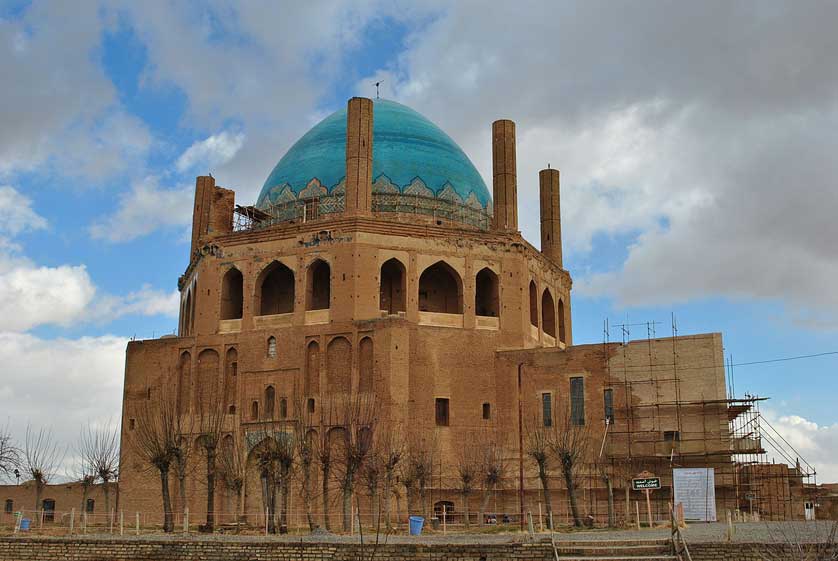
Situated 5 km south of the Zanjan-Takestan Road, Sultanieh is a worthwhile stop on the way from Qazvin to Zanjan. The main reason to visit is to see the Gonbad-e Sultanieh, a spectacular 14th century domed mausoleum.
History
Sultanieh was founded by the Mongol king Arghun Khan (1284-1291) in the last decade of the 13th century partly as atonement for the wholesale destruction wrought on Iran during his people's conquest of the country. The name Sultanieh means "Town of the Sultans".

Intended to be the new imperial capital, Sultanieh was rapidly built on a grand scale. The completed city was almost as large as Tabriz and flourished as a centre of commerce and trade. The city underwent further expansion during the 14th century under the leadership of Arghun Khan's sons before being laid to waste in 1383 by the armies of Tamerlane.
Gonbad-e Sultanieh
The 14th century mausoleum of Gonbad-e Sultanieh is eloquent proof that the Mongols could build as well as destroy. The French archaeologist Andre Godard described it as "the skillful, confident work of a great builder, a consummate technician who was at the same time an artist. Here is a dome with a span of 80 feet built solely of bricks, without any buttresses, pinnacles, or shoulders of any kind, which stands simply by virtue of a perfectly conceived and constructed profile."
Commissioned by the Ilkhanid king Uljaitu (1304-1316) who had converted to Islam from Christianity (after having also been a Buddhist in his earlier years), the mausoleum was intended to house the remains of the Imams Ali and Hossein which were kept in shrines in Najaf. When the Shia clerics of Najaf refused to allow their removal, Uljaitu settled on the using the Gonbad-e Sultanieh as his own mausoleum and reconverted to Buddhism before his death.
The three storey octagonal structure is the second largest mausoleum in the Islamic world after the Hagia Sophia in Istanbul. The peak of the single egg-shaped dome is 51 meters above the floor of a main hall which is 25 meters across with walls 7 meters thick at the base. Carved stucco work, murals and turquoise painted tiles adorn the inside walls of the building.
Access - how to get to Soltanieh
From Qazvin, the nearest large town coming from Tehran to Soltanieh, there are buses to Tehran (approx. 3 hours), Hamadan (3-4 hours), Kermanshah (6 hours), Rasht and Mashhad. There are also shared taxis (savaris) for Rasht, Hamadan and Zanjan. There are trains from Qazvin to Tehran (2 hours), Zanjan (2 hours, 30 mins) and sleepers to Tabriz.
From Zanjan, there are buses and trains to Tehran (4 hours) and an overnight train to Tabriz (8 hours, 30 mins).
To get to Soltanieh from Qazvin or Zanjan, take a savari. It is about 30 minutes by savari from Zanjan's Honarestan Square.
Will Yong and Kazem Vafadari
Book Hotel Accommodation in Iran
Hotels in Iran - Booking.com
Hotels in Tehran - Booking.com
Hotels in Esfahan - Booking.com
Hotels in Kish - Booking.com
Hotels near Imam Khomeini International Airport (Mahmudabad)
Hotels in Mashhad - Booking.com
Hotels in Shiraz - Booking.com
Hotels in Yazd - Booking.com
Book Hotel Accommodation in The Middle East
Hotels in Dubai & UAE - Agoda
Hotels in Egypt - Agoda
Hotels in Jordan - Agoda
Hotels in Kuwait - Agoda
Hotels in Lebanon - Agoda
Hotels in Qatar - Agoda
Hotels in Saudi Arabia - Agoda