Golestan Palace, Tehran
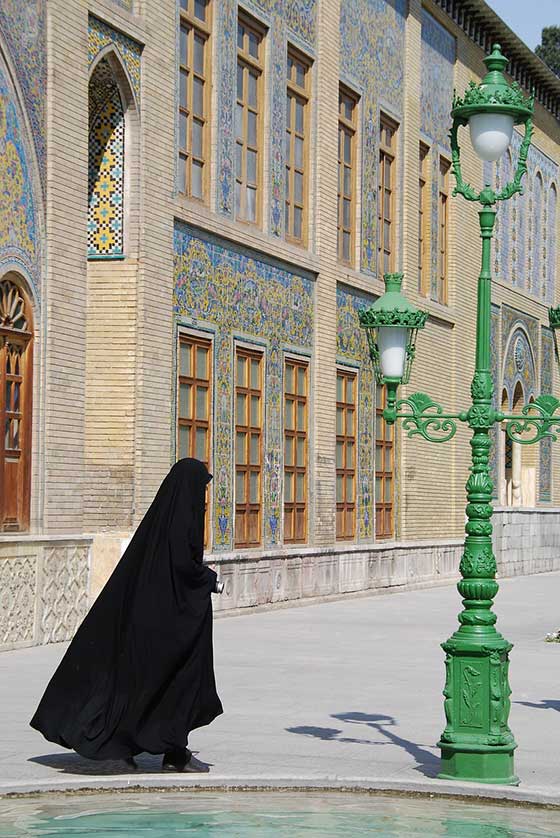
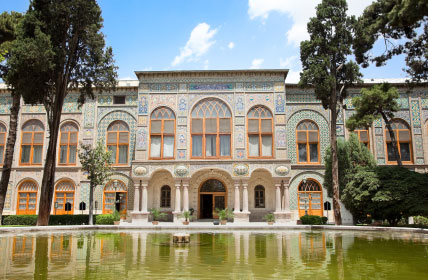
Golestan Palace
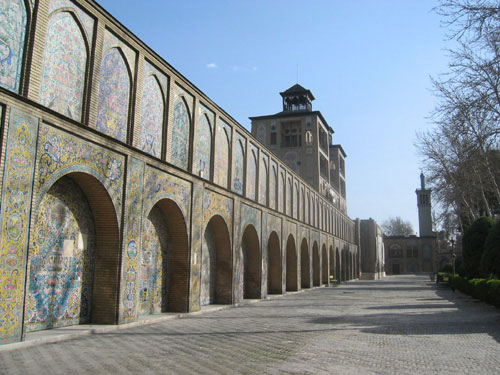
Located on Khordad Square, the Golestan Palace (Palace of Flowers; کاخ گلستان; Kakh-e Golestan) is a collection of buildings set in a walled park veined with canals rushing down from the Tochal mountains.
The buildings that make up this magnificent complex are some of the oldest in Tehran and mix both Persian and European architectural styles, in particular, French.
History
Golestan Palace stands on the site of the historic Arg (citadel) of Tehran which was originally built in the time of Shah Abbas (r. 1588-1629) of the Safavid dynasty.
The Arg became the official royal residence when Agha Mohammad Khan Qajar moved the capital of Iran to Tehran and further palace buildings were constructed during the reign of Karim Khan Zand (r. 1750-1779). Buildings commissioned by Naser Al-din Shah (r. 1848-1896), such as the Shams-ol-Emaneh ("Edifice of the Sun") and the Emarat-e Badgir ("Building of the Wind Towers") show traces of a European architectural style and building technology that the modernising king was influenced by on his travels.
Golestan Palace became the official residence and seat of government of the Qajar court, a time when foreign dignitaries were invited to Golestan and compared its artistry to the royal buildings of Europe.
The palace was rebuilt in 1865 by architect Haji Ab ol Hasan Mimar Navai on the orders of Naser Al-din Shah and most of the buildings we see today date from that period.
During the Pahlavi dynasty (1925-1979), the Golestan Palace was still used for formal occasions, but the Pahlavis built their own, more modern palace in Niavaran in north Tehran.
However, both the coronation of Reza Shah on the Marble Throne and of his son, the last Shah of Iran, Mohammad Reza Pahlavi in the Museum Hall, took place at Golestan Palace.
As part of Reza Shah's modernization drive in the capital, many buildings at Golestan were destroyed between 1925 and 1945.
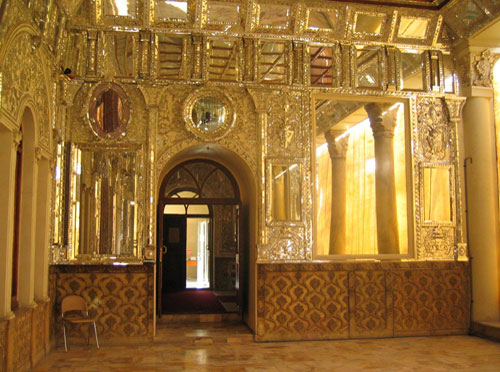
Both the Eyvan-e Takht-e Marmar ("Terrace of the Marble Throne") and the Talar-e Aineh ("Hall of Mirrors") are famous for the spectacular mirror work that covers their walls.
Elsewhere can be seen fine examples of Iranian stained glass, mosaic tiles and painting. Several buildings house collections of paintings and gifts given to Qajar kings by European dignitaries as well as paintings by Iranian masters. The park itself with its tranquil pools and planted areas is an oasis of calm in the heart of the busy city.
The Golestan Palace complex is made up of 17 buildings with eight key structures.
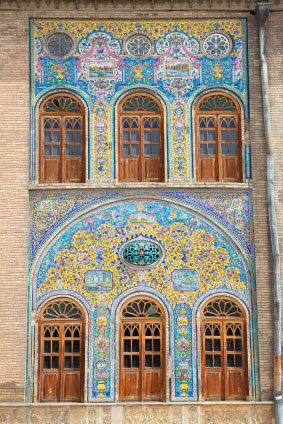
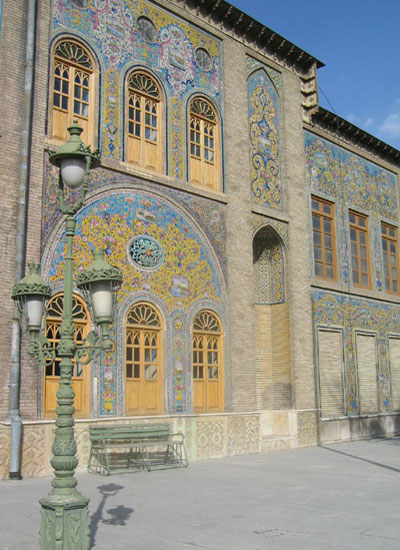
Takht-e Marmar (Marble Throne Verandah)
Constructed during the reign of Fath Ali Shah in 1806 in yellow marble from Yazd, the Takht-e Marmar was used for the coronation of Qajar kings and Reza Shah in 1925. Made from over sixty pieces of stone the raised dais is supported by carved human figures.
Khalvat e Karim Khani (Karim Khani Nook)
The Khalvat e Karim Khani, in the corner of the same building as the Marble Throne, was once part of the residence of Karim Khan of the Zand dynasty. There is a much smaller throne with less ornamentation. Nasser al-Din Shah of the Qajar dynasty was known to smoke his water pipe admiring his beautiful surroundings. His marble tombstone has been placed here. Next door is the Negar Khaneh which displays the work of Iranian painters, many of them depicting the Qajars in their royal finery and jewels (now in the National Jewels Museum). The exhibition is divided into two between early and late Qajar painting.
Talar e Brelian (Brilliant Hall)
The Talar e Brelian (Brilliant Hall) is so called because of its dazzling mirror work and crystal chandeliers. The hall was built on the order of Nasser ed Din Shah to replace a previous building.
Talar-e Salam (Salam Hall)
The Talar-e Salam was a reception hall meant to dazzle its visitors including European dignitaries who visited the Qajar court. Royal jewels (now in the National Jewels Museum) were on display inside glass cases along with Iranian and European paintings on the walls. Plaster molding decorates the ceiling and walls while the floors are mosaic. Under the hall is a gallery holding various items from Persian history including a collection of Qajar seals, the Helmet of King Ismail I and the ceremonial Bow and arrows of King Nader.
Talar-e Adj (Ivory Hall)
The Talar-e Adj (Ivory Hall) was used as a dining hall and displays gifts to the Qajar rulers from various European royalty.
Talar-e Zoruf (Containers Hall)
The Talar-e Zoruf exhibits a priceless collection of porcelain from European monarchs including pieces given by Napoleon Bonaparte, Czar Nicholas I and Queen Victoria.
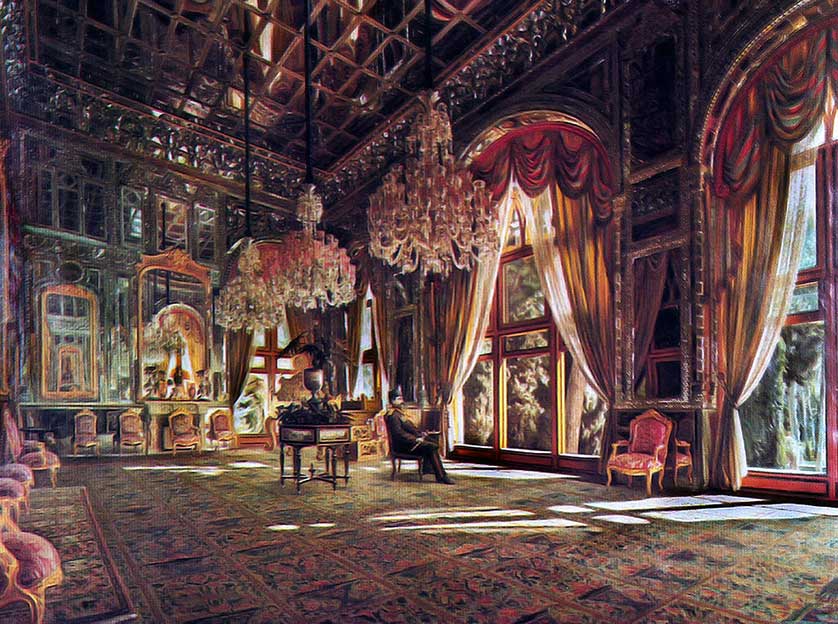
Talar-e Ayaheh (Mirror Hall)
For many visitors the Talar-e Ayaheh or Talar-e Aineh (Mirror Hall) is the highlight of the Golestan Palace. The lavish hall was constructed between 1874 and 1877 and once housed the Peacock Throne (now in the National Jewels Museum).
Talar-e Almas (Diamond Hall)
Like the Mirror Hall, the Talar-e Almas or Diamond Hall has magnificent mirror work and dates back to the era of Fath Ali Shah, the second of the Qajar shahs who ruled from 1797 to 1834 and is remembered for his long beard which trailed below "his wasp-like waist," the huge number of children he fathered from his vast harem and his disastrous wars with Russia.
Emarat e Badgir (Building of Windcatchers)
These elegant badgirs or windcatchers which give the structure its name channel cool air into the rooms below which are decorated with fine stained glass windows.
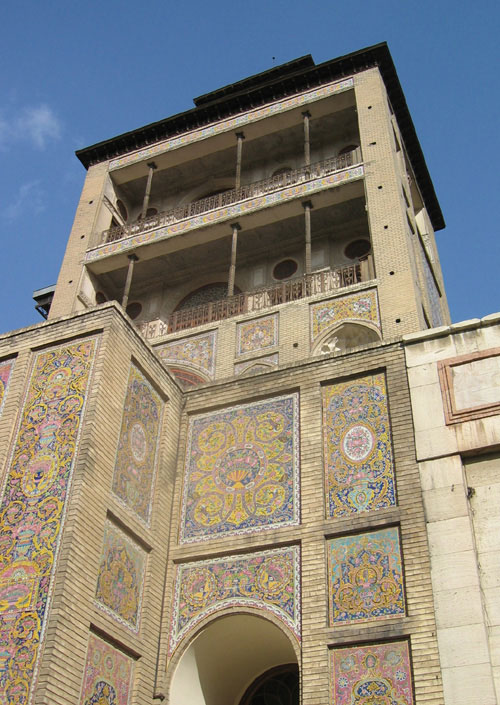
Shams-ol-Emaneh (Edifice of the Sun)
Built between 1865 and 1867, the Shams-ol-Emaneh is the tallest structure at the Golestan Palace and afforded the shahs views over their capital. There are two identical towers lined with fine tile work and with arched windows. The two towers are based on the design of the Ali Qapu Palace in Esfahan.
Abyaz Palace
The Abyaz ("White") Palace now houses an Ethnological Museum with mannequins dressed in Persian folk costumes. It was originally built to house the gifts sent to the shah from the Ottomans.
Howz Khaneh (Pond House)
The Howz Khaneh (Pond House), so called because of the small ponds and stone fountains once in use in the room to keep it cool in summer. Now the room houses the works of European painters presented to the Qajar court.
Access
Golestan Palace (in Farsi & English)
Panzdah Khordad
Arg Square, Tehran
Tel: 021 3311 3335
Hours: 9am-6pm
Imam Khomeini Station on lines 1 and 2 of the Tehran metro is north of the Golestan Palace. Panzdah-e-Khordad Station on Line 1 is slightly closer. The Golestan Palace is a 20-minute walk south east from the National Museum of Iran across City Park.

For a full list of Tehran's places of interest click here
Book Hotel Accommodation in Iran
Hotels in Iran - Booking.com
Hotels in Tehran - Booking.com
Hotels in Esfahan - Booking.com
Hotels in Kish - Booking.com
Hotels near Imam Khomeini International Airport (Mahmudabad)
Hotels in Mashhad - Booking.com
Hotels in Shiraz - Booking.com
Hotels in Yazd - Booking.com
Book Hotel Accommodation in The Middle East
Hotels in Dubai & UAE - Agoda
Hotels in Egypt - Agoda
Hotels in Jordan - Agoda
Hotels in Kuwait - Agoda
Hotels in Lebanon - Agoda
Hotels in Qatar - Agoda
Hotels in Saudi Arabia - Agoda