Famous Iranians - Jalal ad-Din Muhammad Rumi (September 30, 1207 - December 17, 1273)
Olivia He

- 13th century Persian Muslim poet, jurist, sage, mystic and theologian
- Name literally means "Majesty of Religion" (Jalal means "majesty" and Din means "religion")
- Known in the English-speaking world as Rumi
- Major work: The Mathnawi
Life
Rumi was born in Balkh (present day Afghanistan), but as the Mongols invaded Central Asia around 1215, his father, Baha' ud-Din Walad (a theologian, jurist, scholar, and mystic), headed west with his entire family and a group of disciples in tow.
On the road, Rumi's life changed forever as he encountered Attar, one of the most famous mystic Persian poets in Nishapur (now located in the Iranian province of Khorasan and the birthplace of Omar Khayyam). Attar immediately noticed Rumi's spiritual eminence, and gave 18-year-old Rumi his own copy of Asramama, a book about the entanglement of the soul in the material world and which later on became the inspiration for Rumi's own works. From Nishapur, Walad and his family and disciples continued on towards Asia Minor (Turkey) where they finally settled in Konya (Iconium).
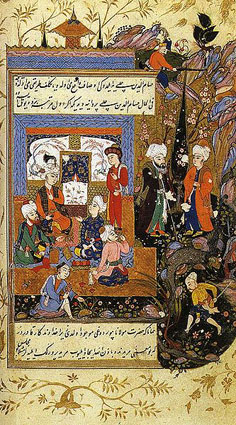
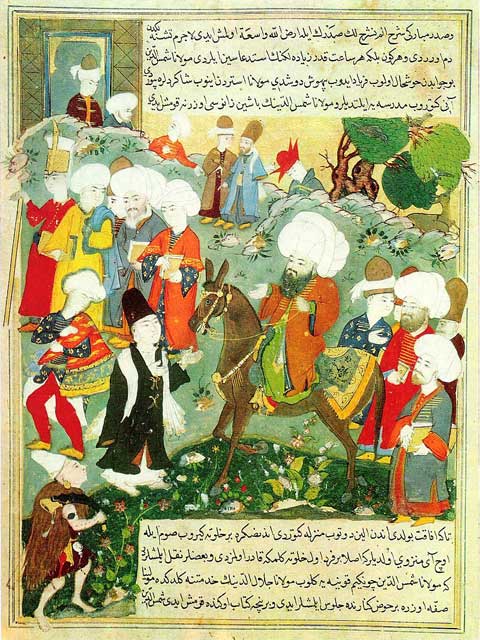
Turkey is where Rumi spent the majority of his life and produced his major works. Walad became the head of a madrassa (religious school) and when he died Rumi succeeded him at the age of 25. Following his father's death one of Walad's students, Sayyed Burhan ud-Din-e Muhaqqiq, continued to train Rumi in the religious and mystical doctrines of Rumi's father.
A meeting with the dervish Shams ad-Din Tabrizi in the late fall of 1244 changed his life completely. Shams is considered one of the spiritual masters during Rumi's time and guided Rumi into Islamic mysticism. One day Shams suddenly and simply vanished without any trail. Rumi's love and grief for Shams found their way out in music, dance, and lyric poems, the Divan-e Shams-e Tabriz, Rumi created to essentially memorialize Shams. Following Shams' disappearance, Rumi left Konya in search of his friend. Journeying as far as Damascus (in present day Syria), Rumi returned with the proud realization that Shams and himself were in fact one and the same.
Teachings of Rumi
The general theme of Rumi's thoughts concerns the concept of Tawhid (unity), specifically the union with his beloved (the primal root) from which/whom he has been cut and fallen aloof, as well as his longing and desire for re-unity. This theme is common throughout Persian literature and especially among mystics and Sufis.
Rumi is considered an example of "insane-e kamil", the perfected or completed human being. This ability of Rumi's to reach out to everyone is one of the widely accepted reasons for his popularity. Rumi had a way of communicating the highly personal and often confusing world of personal/spiritual growth and mysticism in a very forward and direct fashion. He did not offend anyone, in fact quite the opposite - he included everyone. Rumi is not bound by cultural limitations. In many ways, Rumi's life is evidence that people of all religions and backgrounds can live together in peace and harmony.
Rumi's major work is the Mathnawi, a vast 6 volume work of spiritual teaching and Sufi lore in the form of stories, scenes from every day life, Qur'anic revelations and exegesis, and lyric poetry of extraordinary quality. The Mathnawi is one of the enduring treasures of the Persian-speaking world, known and memorized by most.
Legacy of Rumi
Rumi's importance is considered to transcend national and ethnic borders. His influence has spread to Persian-speakers in Afghanistan and central Asia, and beyond to Turkey and India, who view him as one of their most significant classical poets and an influence on countless poets throughout history. His works are widely read in Iran, Afghanistan, Tajikistan, Uzbekistan and in translation especially in Turkey, Azerbaijan, the US, and South Asia. Aside from his Persian poetry, he also wrote some verses in Arabic, Greek, and Oghuz Turkish.
Rumi's poetry forms the basis of quite a bit of classical Iranian and Afghani music and his teachings are considered one of the best introductions to the philosophy and practice of Sufism. Most recently, English interpretations of Rumi's poetry, sung by artists such as Madonna, Goldie Hawn, and Demi Moore, have made it onto Billboard's Top 20 list.
The Mevlevi Order
Following Rumi's death, the Mevlevi Sufi Order was founded in 1273 by his followers. The Mevlevi, better known as the "Whirling Dervishes," believed in performing their worship in the form of dance and music ceremony called the "Sema". Sema represents a mystical journey of spiritual ascent through mind and love to "Perfect." In this journey the seekers symbolically turn towards the truth, grow through love, abandon the ego, find the trust, and arrive at the "Perfect." The music accompanying this traditional ritual consists of settings of poems from the Mathnawi.
Rumi's tomb in Konya is currently a place of pilgrimage, and still where the Mevlevi order is centered.