Famous Iranians - Mohsen Makhmalbaf
Mariam Noronha
From a little boy born into a poor family who went on to join an Islamic militant group to a film maker and writer, Mohsen Makhmalbaf's path to self-discovery has been marked by several highs and lows. His films, screenplays and writings have captured the interest of a global audience and won him international acclaim.
Actor, writer, director, editor, production designer, sound designer and art director, Makhmalbaf's work in Iranian cinema covers a wide spectrum. Here is a look at his life and works.
The Early Years
Makhmalbaf was born into a poor family in southern Tehran on 29 May, 1957. As an adolescent driven by a revolutionary streak he dropped out of school and joined an Islamic militant group in opposition to the Shah's regime. He was only 17 when he was arrested and sentenced to imprisonment. He was serving a five-year sentence when the Islamic revolution came to power in 1979.
During imprisonment Makhmalbaf never thought about a bright future, let alone harbored dreams of international fame. Surprising as it may be, this acclaimed film maker's religious beliefs kept him away from films in the early years of his life. His release from prison was a sort of coming of age for him in terms of his creativity. It was then that he started writing novels and scripting stage plays.
Makhmalbaf: The Film Maker
Mohsen Makhmalbaf turned director with Nasouh Repentance in 1982 in which the protagonist of the film, a bank clerk seeks true repentance in the face of death. Strong religious themes and poor cinematic quality continued to dominate the trilogy that he directed after this, right up to Boycott his fourth film released in 1985. Despite the didactic nature of his first few films, his early initiatives taught him the basics of film making.
Landmark Films
Audiences started taking notice of Makhmalbaf's work with The Peddler (1987), a moving three-episode film about a society plagued by diminishing values. It was with this cinematic effort that he began questioning the very values that he had propagated in his previous films. He followed this up with The Cyclist (1989) another moving film about the struggle of an Afghan man, who is forced to ride a bicycle to raise money to treat his ailing wife and Marriage of the Blessed (1990) revolving around a disillusioned war veteran.
Testing Times
A Time of Love and The Nights of the Zayandeh-Rude (1991) were two films with which Makhmalbaf ventured in to forbidden territory by depicting physical love and questioning the revolution. In doing this he earned the ire of fundamentalist groups and his image as an Islamic director took a beating.
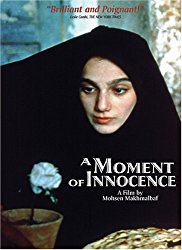
Makhmalbaf faced censorship in his own country when his films A Moment of Innocenceand Gabbehwere screened at the 1996 Fajr Film Festival but kept from distribution in Iran until after a successful run at international film festivals and European openings.
Disappointed with censorship codes in Iran, Makhmalbaf vowed never to make another film in Iran. His film, The Silence (1998) revolving around a blind boy who makes a living by tuning stringed instruments was shot in Tajikistan.
Awards and Recognition
Makhmalbaf's films have won international acclaim at various film festivals. Here are a few of the director's awards and nominations:
- Special Jury Award, Istanbul International Film Festival, 1993, for Nassereddin Shah, Actor-e Cinema.
- Screenwriter's Critic and Writer's Catalan Association, Catalonian International Film Festival and Best Director, nomination for Best Film for Gabbeh.
- Tokyo International Film Festival Award, 1996, Best Artistic Contribution for Gabbeh.
- Locarno International Film Festival, 1996, Special Mention for Nun va Goldoon.
- Venice Film Festival, 1998, Golden Lion Award nomination for Sokhout.
- Cannes Film Festival, 1999, Golden Palm Award nomination for Ghesse hayekish (with others).
Mohsen Makhmalbaf was the editor and screenplay writer for his daughter Samira's directorial debut film The Apple a fact based documentary style film about two blind sisters confined to their home by their parents, perhaps his way of passing the baton on to the next generation of Iranian film-makers.